Join us for the 2026 Cheriton Research Symposium, an annual showcase of research excellence made possible by David R. Cheriton’s generous investment in education.
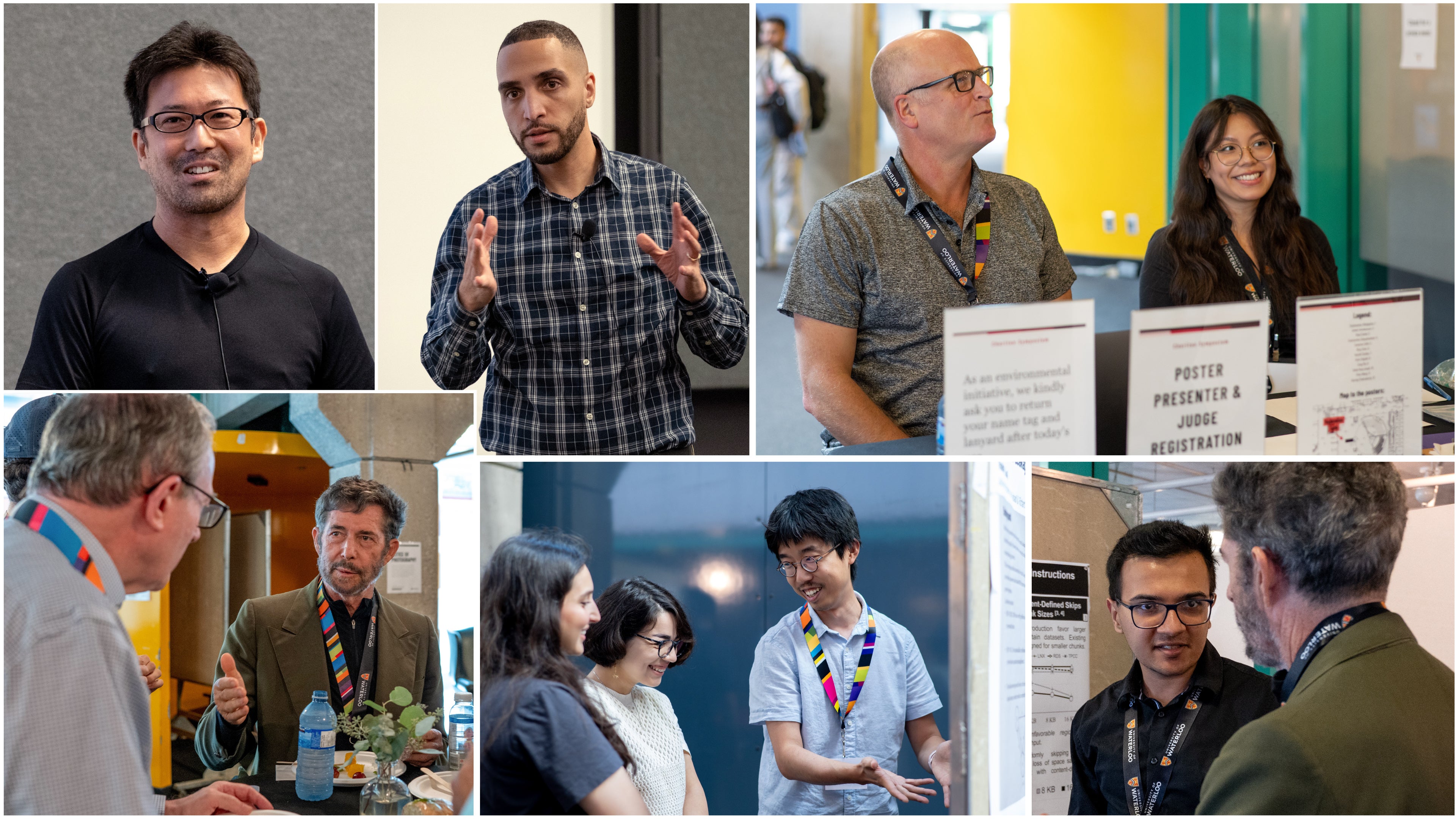
This year’s symposium features morning presentations by Professors Lila Kari, Florian Kerschbaum and Khuzaima Daudjee, followed in the afternoon by poster presentations by graduate scholars at the Cheriton School of Computer Science.
2026 Cheriton Research Symposium Schedule
| Time | Event |
|---|---|
| 10:00 a.m. to 10:05 a.m. |
Raouf Boutaba, Director, Cheriton School of Computer Science | DC 1302 Welcome and Opening Remarks Refreshments will be served |
| 10:05 a.m. to 11:00 a.m. |
Lila Kari, Cheriton Faculty Fellow | DC 1302 Beyond Ancestry: Learning Environmental Signatures from DNA Genomes are usually read as records of ancestry and evolution. Could they also carry other information — for example, an imprint of the environments in which organisms live? If so, extremophiles — organisms thriving under extreme conditions — offer the best chance of detecting it. Biography: Lila Kari is a Professor and Cheriton Faculty Fellow in the Cheriton School of Computer Science at the University of Waterloo. Her research spans natural computing, biomolecular computation, comparative genomics, and biodiversity informatics, with a particular interest in how machine learning methods can reveal structure in biological information. She is the author of more than 250 peer-reviewed articles and has received the Rolf Nevanlinna doctoral thesis award and the Rozenberg Tulip Award for DNA Computer Scientist of the Year. She is Editor-in-Chief of Theoretical Computer Science C and of the Springer Natural Computing book series, and previously held a Canada Research Chair in Biocomputing. |
| 11:00 a.m. to 11:30 a.m. |
Florian Kerschbaum, Cheriton Faculty Fellow | DC 1302 Privacy-Preserving Collaborative Analytics Artificial intelligence enables us to extract valuable insights from data, but that data is often siloed across different organizations or entities. This creates a difficult trade-off: either keep the data private and forgo potentially valuable analyses or share it and risk revealing sensitive information. Fortunately, there is another option: performing data analysis directly on encrypted data. While naïve approaches can be prohibitively expensive in terms of computation and communication, carefully designed protocols can significantly reduce these costs. Biography: Florian is a professor in the David R. Cheriton School of Computer Science at the University of Waterloo (joined in 2017) and a member of the CrySP group. He was the NSERC/RBC chair in data security (2019 – 2025) and served as the inaugural director of the Waterloo Cybersecurity and Privacy Institute (2018 – 2021). Before he worked as chief research expert at SAP in Karlsruhe (2005 – 2016) and as a software architect at Arxan Technologies in San Francisco (2002 – 2004). He holds a Ph.D. in computer science from the Karlsruhe Institute of Technology (2010) and a master’s degree from Purdue University (2000). He is an IEEE Fellow (2026), an ACM Distinguished Scientist (2019), a winner of the Outstanding Young Computer Science Researcher Award from CS-Can | Info-Can (2019) and a winner of the Faculty of Math Golden Jubilee Research Excellence Award (2022). He is interested in security and privacy in the entire data science lifecycle. |
| 11:30 a.m. to 12:00 p.m. |
Khuzaima Daudjee, Cheriton Faculty Fellow | DC 1302 Toward Dynamic Data Systems We have long asked two related questions: given a workload, how should system resources be managed? And given system resources, how should we handle workloads? I will present research toward answering these two questions, drawing on examples from our systems work to illustrate how resource management and workload execution can adapt to changing demands and constraints. Biography: Khuzaima is an ACM Distinguished Scientist, a member of both the Data Systems group and the Systems and Networks group and a professor at the University of Waterloo. He is interested in designing and building large-scale systems that store and manage data, including system-level support for data-intensive applications such as streaming, graph processing, and machine learning. His work has been recognized with several best paper and system demonstration awards. |
| 12:00 p.m. to 1:00 p.m. |
Lunch | DC 1301 (fishbowl) By invitation |
| 1:00 p.m. to 4:00 p.m. |
Poster Presentations, Cheriton Graduate Scholars | DC Atrium |
| 4:00 p.m. to 4:30 p.m. |
Poster Awards Ceremony | DC 1301 |
2026 Cheriton Research Symposium Poster Presenters
| Presenter | Supervisor(s) | Poster Title |
|---|---|---|
| Avantika Agarwal | Shalev Ben-David Eric Blais |
The Information Complexity of Decision Trees |
| Yee Man Choi | Freda Shi Krzysztof Czarnecki |
The Illusion of Choice: Assessing Impact of Manipulated LLMs |
| Anudeep Das | N. Asokan Florian Kerschbaum |
Espresso: Robust Concept Filtering in Text-to-Image Models |
| Zhaoyi Ge | Yizhou Zhang | Selective Compilation of Lexical Effect Handlers |
| Tony He | N. Asokan Yaoliang Yu |
Locket: Robust Feature-Locking Technique for Language Models |
| Xinyu Shi | Jian Zhao | Interactive Visual Abstractions for Computational Creativity |
| Haochen Sun | Xi He | GPM: The Gaussian Pancake Mechanism for Planting Undetectable Backdoors in Differential Privacy |
| Gengyi Sun | Shane McIntosh | Recovering Revisions of Pull Requests with Altered History |
| Zhiyuan Sun | Victor Zhong | WorldComposer: Learning and Grounding Symbolic Abstractions for Long-Horizon World Modeling |
| Helia Yazdanyar | Sepehr Assadi | Fully Dynamic Algorithms for Coloring Triangle-Free Graphs |
| Shufan Zhang | Xi He | No Data Left Behind: Right-Grained Secure Data Management for Data with Mixed Sensitivity |