A team of software engineering researchers at the Cheriton School of Computer Science has received a Distinguished Artifact Award for “Automated Dependency Optimization for Artifact-Based Build Systems,” a paper presented at ISSTA 2026, the 35th ACM SIGSOFT International Symposium on Software Testing and Analysis.
The research, conducted by PhD candidate Hongxu Xu, recent PhD graduate Zhenyang Xu, along with Professors Shane McIntosh and Chengnian Sun, was one of four papers to receive a distinguished artifact award, selected from 59 artifact submissions across 210 accepted papers out of a total of 888 submissions.
“Although a team effort, I’d like to recognize Hongxu’s hard work and dedication to this project,” said Professor Sun. “In particular, his efforts led to the introduction of DepReduce, the first automated approach to optimize declared dependencies in artifact-based build systems.”
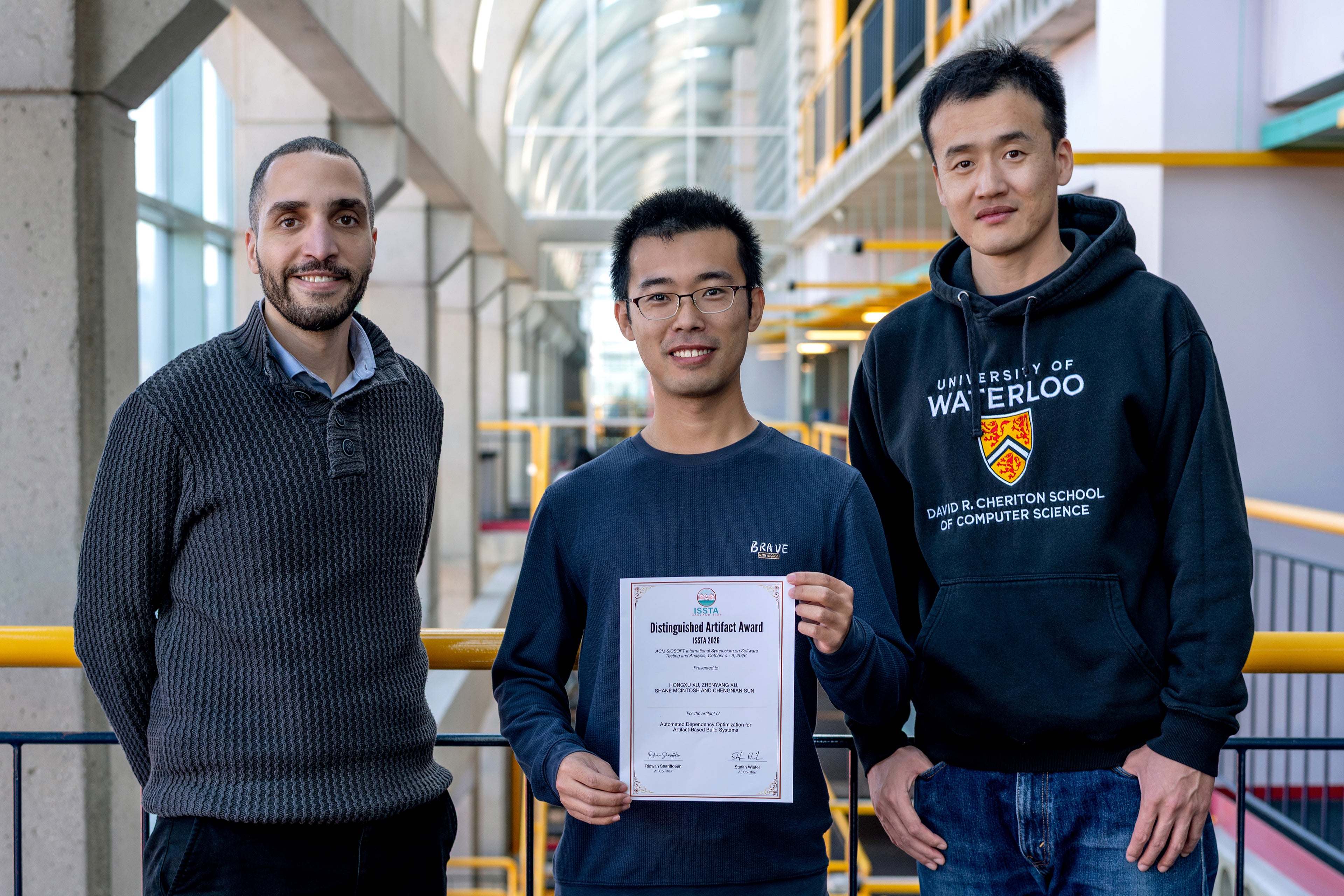
Left to right: Professor Shane McIntosh, PhD candidate Hongxu Xu and Professor Chengnian Sun (Zhenyang Xu was unavailable for the photo)
Hongxu Xu is a PhD student, advised by Chengnian Sun. His research focuses on compiler optimizations, software testing, and formal verification. Before his PhD, he spent nearly seven years in industry, most recently as a Senior SDE at ByteDance, and previously at Microsoft STC-Asia.
Zhenyang Xu defended his PhD thesis, Pushing the Limit of Language-Agnostic Program Reduction, in January 2026 under the supervision of Chengnian Sun. His research focused on software testing and debugging, with a particular emphasis on compilers. He is currently a Compiler Engineer with Huawei Canada.
Shane McIntosh is an Associate Professor at the Cheriton School of Computer Science. He leads the Software Repository Excavation and Build Engineering Labs, also known as the Software REBELs. Previously, he was the Canada Research Chair (Tier 2) in software build automation and an Assistant Professor at McGill University. In his research, he uses empirical methods to study and improve software build systems, devops pipelines, developer experience platforms, and software quality.
Chengnian Sun is an Associate Professor and a Cheriton Faculty Fellow at the Cheriton School of Computer Science. His research interests lie at the intersection of software engineering and programming languages, with a focus on improving software quality and enhancing developer productivity through better tools, techniques and methodologies. Previously, he worked as a software engineer at Google in Mountain View, California.
More about this award-winning research
Software build systems serve as the backbone of software development, transforming source code into deliverables. How quickly software can be delivered depends, in part, on how efficiently these systems build and rebuild projects. Incrementality and parallelism are two critical capabilities that span most build systems and directly affect build performance. Incremental builds ensure that only artifacts affected by changes are rebuilt, while parallelism enables independent tasks to execute concurrently.
Both capabilities are particularly important in large-scale projects, where developers frequently modify code and rebuild software. Effective dependency management is a prerequisite to leveraging these capabilities. A major challenge is avoiding redundant dependencies — those that are declared but unused — which hinder both incrementality and parallelism.
To address these challenges, the research team introduced DepReduce, an automated approach for optimizing declared dependencies in artifact-based build systems. DepReduce operates on the declared dependency graph managed by the underlying build system, and formalizes the optimization objective as minimizing the cumulative rebuild cost triggered by changes to individual targets. To achieve this, DepReduce performs the dependency lifting and dependency flattening operations on the dependency graph in topological order. Importantly, the researchers prove that this approach is both correct and optimal under their defined optimization objective.
To evaluate their approach empirically, the researchers implemented BazelDepReduce, an automated dependency optimization tool for Bazel, an artifact-based build system with native support for multiple programming languages.
In an evaluation of 19 open-source Bazel projects in seven programming languages, BazelDepReduce lowered rebuild costs in 16 projects across six languages, identifying and removing 430 redundant dependencies. The team submitted 16 pull requests with these optimizations, 12 of which were merged by project maintainers. The accepted changes included contributions to Angular and Apache RocketMQ, demonstrating that the approach can deliver improvements in established software systems. The researchers also adapted BazelDepReduce to support Buck and Cargo, offering evidence that their implementation can be extended to other artifact-based build systems.
The results show their approach can effectively reduce rebuild costs on selected Bazel projects spanning multiple languages. Important directions for future work include assessments across build systems and deeper integration into continuous integration workflows.
To learn more about the research on which this article is based, please see Hongxu Xu, Zhenyang Xu, Shane McIntosh, Chengnian Sun. Automated Dependency Optimization for Artifact-Based Build Systems, Proceedings of the ACM on Software Engineering, 2026, Vol 3, Article No. ISSTA100, pp. 2294– 2315.