Master’s candidate Setareh Alagheh Band, Research Professor Noura Limam and University Professor Raouf Boutaba have received a Best Paper Award for “SARA: SLA-Aware Resource Allocation for Efficient RAN Slicing.”
Presented at CNSM 2026, the 22nd IEEE/ACM/IFIP International Conference on Network and Service Management, held in Madrid, Spain, the paper addresses the challenge of allocating resources efficiently in 5G networks while ensuring that each logical network slice meets its service-level agreement (SLA). An SLA defines the performance guarantees that a network operator commits to providing, such as throughput, latency, reliability, and availability.
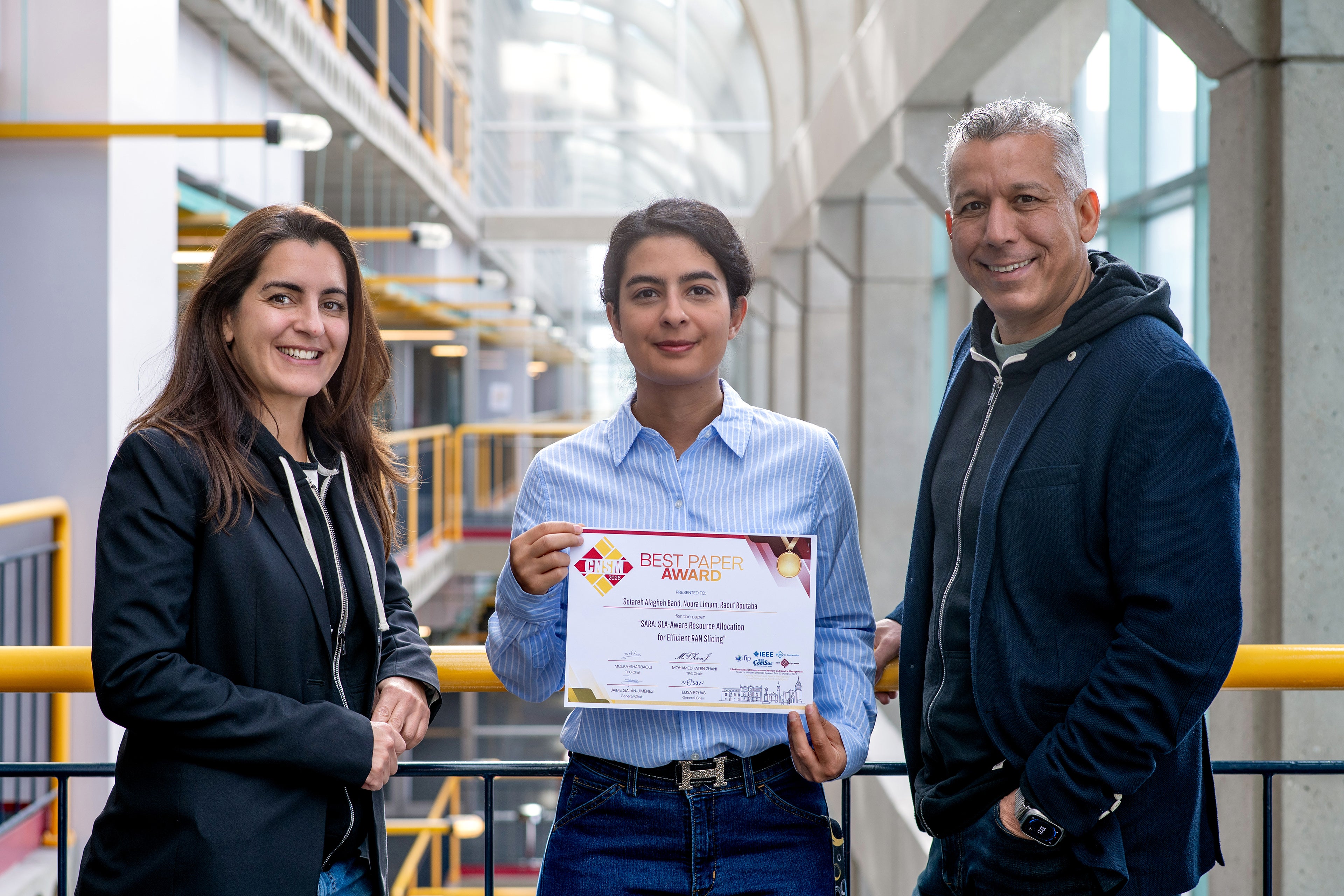
Left to right: Research Professor Noura Limam, master’s candidate Setareh Alagheh Band, University Professor Raouf Boutaba
Noura Limam is a Research Professor at the Cheriton School of Computer Science. Her research focuses on network operations and management, autonomous networking, and network programmability. She has received best paper awards at NOMS 2026 and SIGMETRICS 2021, the IEEE Communications Society’s CNOM best paper award in 2021, as well as the Salah Aidarous Award at NOMS 2026 in recognition of her outstanding service to the network operations and management community.
Setareh Alagheh Band is a master’s student at the Cheriton School of Computer Science, supervised by Professor Boutaba. Her research focuses on 5G networks and RAN slicing, with an emphasis on innovative solutions and emerging technologies.
Raouf Boutaba is a University Professor and Director of the Cheriton School of Computer Science. He is an internationally recognized researcher whose pioneering contributions to automated network management have helped drive the evolution toward autonomous networking. He is widely recognized for ground-breaking research in network virtualization and network softwarization that is transforming how communication networks are designed, operated and managed. His research has received 23 best paper awards, including 15 from leading network management conferences.
While mobile networks have traditionally shared radio resources among users, 5G introduces network slicing, enabling operators to partition shared infrastructure into multiple logical networks tailored to different service requirements. In the radio access network (RAN), slicing enables differentiated radio resource allocation and scheduling policies to support services with distinct performance requirements.
RAN slicing allows mobile network operators to support a variety of services over shared infrastructure. For example, enhanced mobile broadband slices can support applications such as 4K video streaming that require high data rates but can tolerate some latency. In contrast, applications like industrial automation and real-time robotic control may not need as high data throughput, but ultra-reliable, low-latency communication is essential. This flexibility allows 5G networks to support many services with diverse performance needs and service-level guarantees simultaneously.
Resource scheduling in sliced radio access networks operates at two levels. An inter-slice scheduler distributes resources among slices, while each slice’s intra-slice scheduler allocates resources among the user equipment it serves according to slice-specific policies. Although this two-level scheduling framework provides flexibility and isolation, ensuring that each slice meets its SLA while making efficient use of the limited radio spectrum is challenging, especially as network traffic and radio channel conditions fluctuate over time.
Existing frameworks rely on static per-slice resource allocation rather than sharing resources dynamically across slices based on demand, thereby wasting the radio spectrum when slices are underloaded.
To address this challenge, the researchers developed SARA: SLA-Aware Resource Allocation, an inter-slice scheduling algorithm that dynamically allocates radio resources across slices based on users’ SLA deficits and instantaneous radio channel conditions, while minimizing radio resource consumption. Empirical evaluations showed that SARA kept SLA deficits below 5 per cent while significantly reducing spectrum use by some 40 per cent compared with baseline approaches that saturate the available radio spectrum.