University of Waterloo among founding members of Algorand Foundation’s Global University Program
The University of Waterloo has joined other leading universities around the world to support the Algorand Foundation’s Global University Program.


The following excerpt is from “The quest for high-quality data: Machine learning solutions for data integration, cleaning, and data generation are beginning to emerge,” a blog post written by Cheriton School of Computer Science Professor Ihab Ilyas and Ben Lorica, Chief Data Scientist at O’Reilly Media.
Researchers at the Cheriton School of Computer Science have found that individuals may be more motivated to do work for their favourite charity than for money.
In a study reviewing the efficacy of a new online work-sharing platform designed to put money into the hands of charities, the researchers discovered that people providing their skills and labour toward a specific task tended to do a better job if they knew their favourite charity rather than themselves would be paid for it.
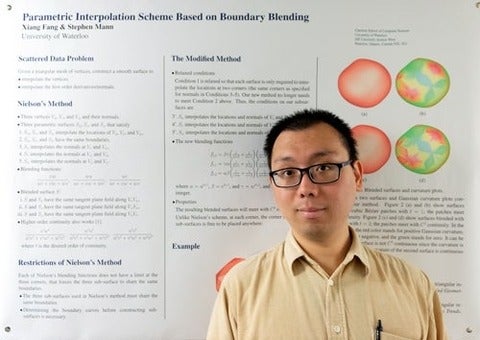
PhD student Xiang Fang received the best graphics poster award at Graphics Interface 2019, the 45th International Conference on Graphics, Visualization and Human-computer Interaction.
Eldon Sprickerhoff is the 2019 recipient of the J.W. Graham Medal in Computing & Innovation.
Haonan Duan has received a prestigious Vector Scholarship in Artificial Intelligence from the Vector Institute.
The key to people trusting and co-operating with artificially intelligent agents lies in their ability to display human-like emotions, according to a new study by Postdoctoral Fellow Moojan Ghafurian, Master’s candidate Neil Budnarain and Professor Jesse Hoey at the Cheriton School of Computer Science.
Cheriton School of Computer Science Professor Jesse Hoey has teamed up with Professor Robert Freeland, a sociologist at Wake Forest University, to conduct novel research at the intersection of computer science and social psychology.
Cheriton School of Computer Science PhD candidate Chang Ge, Professors Ihab Ilyas and Xi He, and their colleague Professor Ashwin Machanavajjhala at Duke University
Blockchain technology creates digital ledgers that record sequential exchanges of information, commonly called transactions. To improve performance, transactions are batched into blocks before they are added to the ledger. Each new block contains a hash value which, like a mugshot, acts as an identifier and proof of the previous state of the ledger.